Back

How to choose the best RFI content library software in 2026

Because of the growing volume of RFIs and questionnaires, the traditional response knowledge base is failing to cope up. As a result, organisations are now searching for better ways to centralise and manage their response knowledge. That is exactly why demand for RFI content library software is growing in 2026.

Modern businesses no longer need just a folder of previous answers. Instead, they need intelligent systems that can organise information, surface accurate responses instantly, automate repetitive documentation tasks, and maintain consistency across teams. Consequently, the role of RFI content management has evolved from simple document storage into a strategic operational capability.

In this guide, we’ll explore the top 5 RFI content library software platforms in 2026, what makes them different, and how to choose the right solution for your compliance, ESG, and supply chain workflows.

Key takeaways

  • Modern RFI content library software goes beyond document storage by combining AI-powered search, workflow automation, and centralised knowledge management for faster and more consistent responses.
  • Growing complexity of questionnaires across compliance, ESG, quality assurance, and supplier governance is driving organisations to adopt structured RFI content management platforms.
  • The best knowledge base for RFI responses should support collaboration, version control, ESG surveys, supplier documentation, and document automation software for RFIs within a single platform.
  • While many tools focus on proposal management, platforms like RightOrigins are specifically designed for compliance, ESG, and supply chain workflows requiring deeper operational governance.

What is RFI content library software?

RFI content library software is a specialised platform designed to store, organise, manage, and retrieve answers used in requests for information, supplier questionnaires, compliance assessments, audits, and ESG surveys.

Unlike generic document management tools, modern RFI content library software combines:

  • AI-powered search
  • Structured response repositories
  • Workflow automation
  • Collaboration tools
  • Version control
  • Document automation software for RFIs

Most importantly, these platforms help teams create a reliable knowledge base for RFI responses that can be reused consistently across departments.

This distinction matters because traditional knowledge systems often struggle to support operational workflows. Shared drives become cluttered, answers go out of date, and teams waste hours searching for the latest approved response.

Consequently, businesses are now prioritising dedicated RFI content management platforms that can reduce manual effort while improving accuracy and audit readiness.

Why traditional knowledge bases fail for modern RFIs and questionnaires?

Many organisations assume that SharePoint folders or internal wikis are enough for managing RFIs. Unfortunately, that approach often breaks down at scale.

Firstly, information becomes duplicated across departments. Secondly, teams lose confidence in whether responses are current or approved. Thirdly, ESG surveys and compliance questionnaires frequently require data from multiple systems and stakeholders, making manual coordination difficult.

As a result, teams spend significant time searching for answers rather than responding strategically. That inefficiency becomes especially costly in high-volume questionnaire environments where accuracy and turnaround time directly impact supplier relationships, audits, and commercial opportunities.

Therefore, modern RFI content library software is increasingly becoming a strategic operational layer rather than simply a storage system.

Why RFI content management matters more in 2026

The need for better RFI content management is being driven by several major shifts across compliance and supply chain operations.

Growing complexity of questionnaires:  Questionnaires are no longer limited to simple supplier onboarding or procurement assessments. Today, organisations are managing highly detailed requests across compliance, ESG, quality assurance, sourcing, and operational governance. Moreover, different stakeholders often ask overlapping questions in different formats, forcing teams to repeatedly search for the same information across disconnected systems. As a result, businesses are increasingly investing in RFI content library software that can centralise approved responses, improve collaboration, and support faster, more consistent questionnaire management across departments.

Evolving regulations and transparency demands: Regulatory expectations around transparency, supplier accountability, sustainability, and operational governance continue to evolve rapidly. Consequently, organisations are under growing pressure to provide accurate, traceable, and audit-ready information across ESG surveys, compliance assessments, and supplier documentation requests. At the same time, customers and regulators now expect faster turnaround times and greater response consistency. This shift has made structured RFI content management a strategic necessity rather than an operational convenience, especially for businesses operating across regulated industries and global supply chains.

AI has changed operational expectations: AI is reshaping how organisations handle documentation workflows. Teams now expect faster response times, automated drafting, and intelligent search capabilities. As a result, businesses are increasingly investing in document automation software for RFIs that can reduce repetitive manual work while improving response quality.

What to look for in an RFI content library software

Not all platforms solve the same problem. Some focus heavily on sales proposals, while others are designed specifically for compliance and supplier workflows.

Before selecting a solution, organisations should evaluate several key capabilities.

AI-powered search: The best RFI content library software should help users locate approved answers instantly, even across large documentation repositories.

Centralised knowledge management: A strong knowledge base for RFI responses should eliminate duplicate answers and maintain version consistency.

ESG survey support: As ESG reporting requirements increase, businesses need platforms capable of handling sustainability questionnaires efficiently.

Workflow automation: Modern document automation software for RFIs should reduce repetitive tasks like formatting, drafting, and response compilation.

Collaboration features: Cross-functional collaboration between QA, compliance, procurement, and supply chain teams is essential for maintaining accurate responses.

Audit readiness: Version history, approval tracking, and structured documentation are becoming increasingly important during audits and regulatory reviews.

Top 3 RFI content library software in 2026

1. RightOrigins

RightOrigins is rapidly becoming one of the strongest platforms for compliance-focused questionnaires and RFI content management.

Unlike traditional proposal software, RightOrigins is purpose-built for QA, compliance, ESG, and supply chain teams. The platform acts as a centralised RFI content library software solution that transforms fragmented documentation into a structured, reusable knowledge system.

One of its biggest strengths is its ability to support ESG surveys, supplier questionnaires, audit workflows, and compliance documentation from a single source of truth.
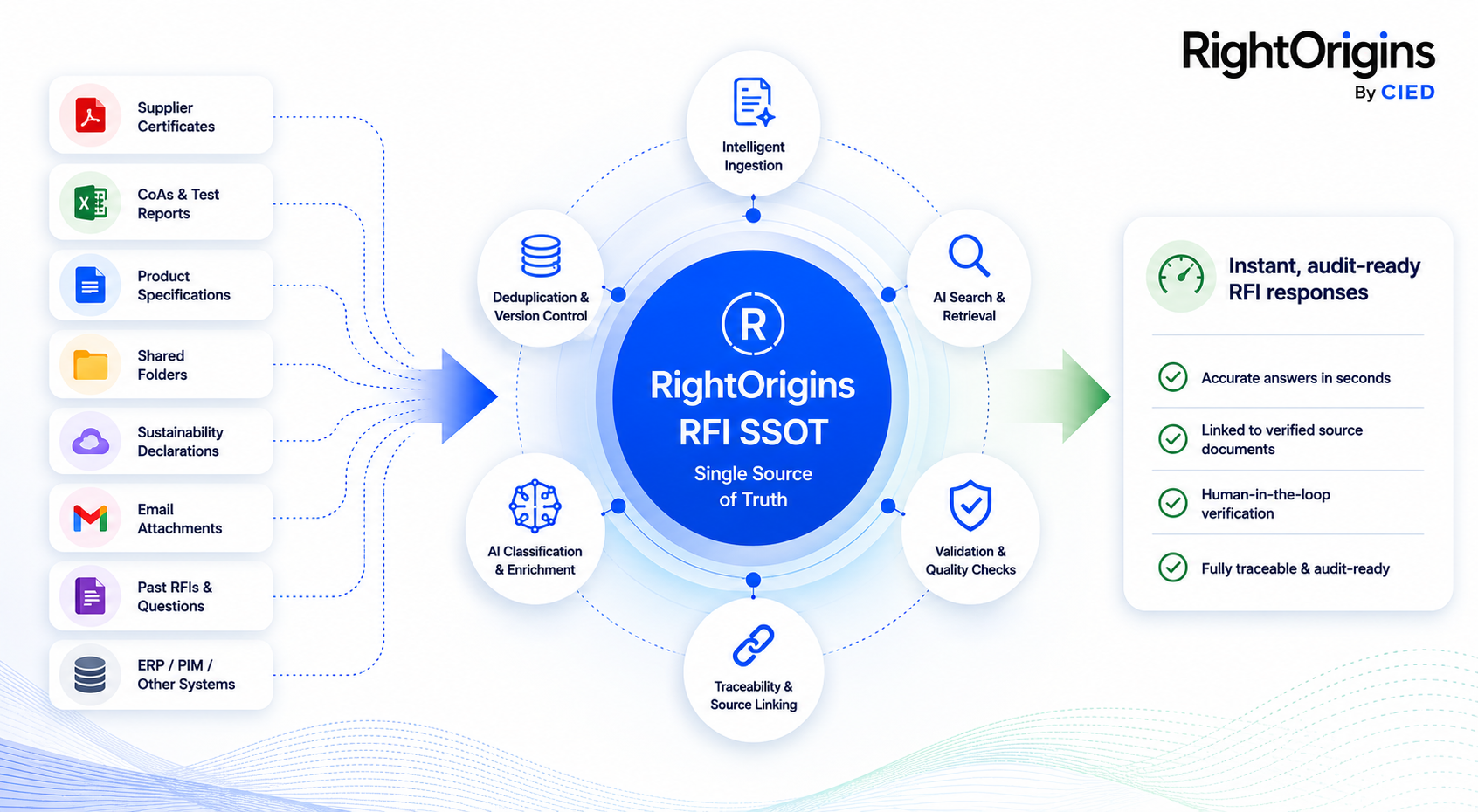
RightOrigins RFI content library system

Key features

  • AI-powered knowledge retrieval
  • Centralised knowledge base for RFI responses
  • Supplier documentation management
  • ESG survey workflows
  • Automated questionnaire responses
  • Compliance-focused document automation software for RFIs

Best for

Compliance teams, supplier quality teams, ESG operations, and manufacturing organisations managing high volumes of questionnaires and audits.

Potential limitation

Less focused on sales proposal workflows compared to legacy RFP platforms.

2. Responsive (formerly RFPIO)

Responsive remains one of the most recognised players in the RFI content management market.

The platform is widely used for enterprise proposal management and questionnaire workflows. It offers strong collaboration capabilities and large-scale response libraries.

RFI content library

Key features

  • Centralised RFI content library
  • AI-assisted response suggestions
  • Workflow management
  • Enterprise integrations

Best for

Large enterprises managing procurement and proposal-heavy workflows.

Potential limitation

Can feel more sales-oriented than compliance-oriented.

3. Loopio

Loopio is another established platform known for helping teams manage repetitive questionnaire responses efficiently.

Its interface is user-friendly, and its content reuse capabilities are particularly strong.

Loopio homepage image

Key features

  • Structured knowledge management
  • Content approval workflows
  • Collaboration tools
  • Response reuse automation

Best for

Teams handling recurring RFPs and RFIs across multiple departments.

Potential limitation

Less specialised for ESG surveys and supplier compliance operations.

Which RFI content library software is best?

The right platform ultimately depends on the operational challenges your organisation is trying to solve.

If your biggest priority is managing ESG surveys, supplier compliance documentation, and audit workflows, RightOrigins offers stronger domain alignment for operational teams.

On the other hand, organisations heavily focused on enterprise proposal management may prefer platforms like Responsive or Loopio.

Meanwhile, companies prioritising rapid AI adoption may find Arphie or Inventive appealing due to their AI-native workflows.

However, regardless of platform choice, the direction of the market is becoming increasingly clear. Businesses are moving away from static repositories and towards intelligent RFI content management systems capable of supporting automation, governance, and operational consistency at scale.

Final thoughts

The demand for RFI content library software is growing because businesses can no longer rely on disconnected spreadsheets, folders, and tribal knowledge to manage increasingly complex stakeholder requests.

Modern RFI content management platforms are helping organisations centralise knowledge, improve response accuracy, automate repetitive workflows, and manage ESG surveys more effectively.

As AI continues reshaping operational workflows, organisations that invest in structured, intelligent knowledge systems will likely gain a significant advantage in compliance readiness, supplier collaboration, and operational efficiency.

For teams managing complex compliance, QA, and supply chain workflows, platforms like RightOrigins represent a broader shift towards smarter, AI-driven knowledge infrastructure rather than traditional document storage.

We use cookies to give you the best experience. By using our site you accept the terms of our Privacy Policy.